Every Load of Laundry Is a Pollution Event: The Microfiber Crisis Hiding in Plain Sight
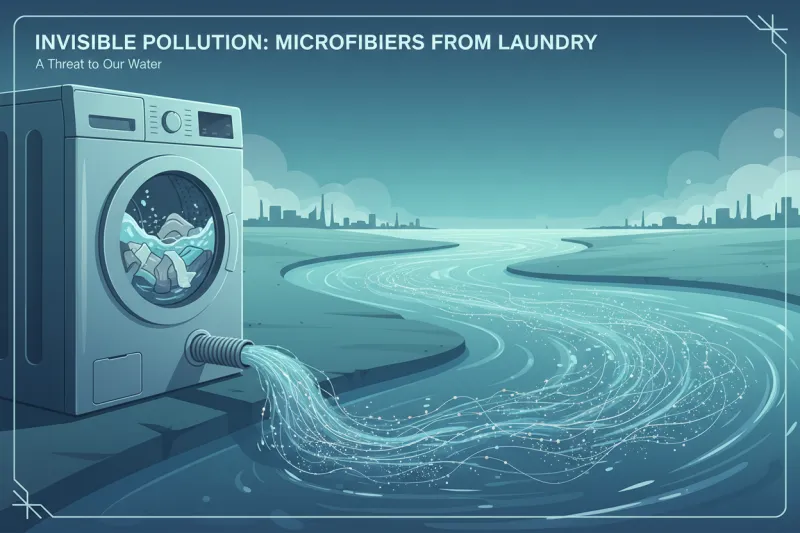
Photo: washing machine synthetic laundry microfiber water pollution, via cdn.shopify.com
There is something almost absurd about the idea that doing laundry — one of the most routine domestic chores in America — contributes to the degradation of the Pacific Ocean. Yet that is precisely what the science tells us. Every time a fleece jacket, a pair of athletic leggings, or a synthetic-blend shirt tumbles through a wash cycle, it sheds an invisible storm of plastic fibers too small to see and, in most cases, too small for existing infrastructure to catch.
The result is a slow-motion environmental catastrophe playing out beneath the surface of every major waterway in the United States.
The Mechanics of Fiber Shedding
To understand why this problem is so difficult to address, it helps to understand why it happens at all. Synthetic textiles — polyester, nylon, acrylic, spandex — are, at the molecular level, plastic. When agitated in water, the individual filaments that make up woven and knitted fabrics break apart at their weakest points. The mechanical friction of a washing machine accelerates this process dramatically.
Researchers at the University of California, Santa Barbara, found that a single synthetic jacket can release more than 1.7 grams of microfibers per wash — translating to roughly 250,000 individual particles. Multiply that figure across the approximately 100 million American households that do laundry regularly, and the numbers become staggering. Estimates suggest that somewhere between 500,000 and 700,000 metric tons of microfibers enter global aquatic environments annually, with the United States contributing a disproportionate share given its per-capita consumption of synthetic apparel.
The problem does not end with the washing machine. Dryers present a secondary release point that receives far less attention. Lint traps capture some material, but ultrafine fibers bypass these screens entirely and are vented directly into outdoor air, where they settle on soil, enter storm drains, and eventually reach coastal waters.
Where Treatment Plants Fall Short
American municipal wastewater treatment facilities were not designed with microplastics in mind. Most plants operate on a three-stage process — screening, biological treatment, and settling — that effectively removes bacteria and larger solids but struggles with particles measured in microns. Studies examining treated effluent from facilities across the Great Lakes region and along the Eastern Seaboard have found that even well-functioning plants allow between 10 and 40 percent of incoming microfibers to pass through untreated.
The volume of water processed daily by a single large urban facility can run into hundreds of millions of gallons. Even a 10 percent pass-through rate, applied to that scale, deposits enormous quantities of synthetic fibers into receiving waterways every single day. From those rivers and estuaries, tidal and current patterns carry the particles into open ocean systems, where they can persist for decades.
Sewage sludge — the solid byproduct of treatment — presents an equally troubling pathway. Much of this material is applied to agricultural land as fertilizer, meaning microfibers captured during treatment are not eliminated; they are simply redirected toward a different environmental sink, one with direct connections to groundwater and runoff.
The Marine Ecosystem Absorbs the Cost
Once microfibers reach saltwater environments, they behave in ways that compound their ecological harm. Their small size and fibrous shape make them highly attractive to filter feeders — mussels, oysters, small crustaceans — that mistake them for food particles. Studies conducted along the California coast and in Chesapeake Bay have documented microfiber contamination in commercially harvested shellfish at concentrations that should concern any American seafood consumer.
Further up the food chain, fish and seabirds ingest fibers directly or through contaminated prey. The fibers can carry adsorbed chemical pollutants — persistent organic compounds and heavy metals that bind readily to plastic surfaces — delivering a concentrated toxic payload alongside the physical obstruction of digestive systems. Marine mammals, including several whale species that feed in U.S. waters, have been found with measurable microplastic burdens in tissue samples.
The cumulative effect on marine biodiversity is still being quantified, but the trajectory is not encouraging.
Solutions That Already Exist
The encouraging dimension of this story is that practical interventions are available right now, and American consumers have more leverage than they may realize.
Washing machine filters represent perhaps the most direct point-of-intervention solution. Devices such as the Filtrol and similar aftermarket filters attach to a machine's drain hose and capture a significant percentage of fibers before they enter the wastewater stream. Independent testing suggests that well-designed filters can intercept between 80 and 90 percent of microfibers released during a standard cycle. France became the first country to mandate the installation of microfiber filters in all new washing machines in 2025 — a regulatory model that advocates are now pressing U.S. legislators to adopt at the federal level.
Laundry bags designed with fine-mesh construction — brands like Guppyfriend have gained traction in the American market — offer a lower-cost alternative for renters and those unwilling to modify their appliances. While their capture efficiency is somewhat lower than dedicated filters, they represent a meaningful improvement over doing nothing.
Textile innovation is advancing on a parallel track. Several American and European brands are developing fabrics engineered to shed fewer fibers through tighter weave structures, reduced filament counts, and novel finishing processes. Patagonia, whose outdoor apparel line is heavily synthetic, has invested in research to understand and reduce the shedding profile of its products. The emerging field of bio-based synthetics — materials that mimic the performance of polyester while degrading more readily in aquatic environments — holds longer-term promise, though commercial viability at scale remains a work in progress.
Consumer behavior also plays a role. Washing clothes less frequently, using cold water and gentler cycles, filling the machine to capacity rather than running partial loads, and choosing liquid detergents over powders (which increase fiber abrasion) all reduce per-wash fiber release.
A Policy Gap That Demands Attention
Despite the growing body of scientific evidence, federal regulation of microfiber pollution in the United States remains limited. The Clean Water Act's framework was written long before synthetic textiles became the dominant material in American wardrobes, and its provisions do not specifically address diffuse, consumer-generated pollution of this kind. Several states — California most prominently — have moved to fill the gap with legislation requiring microfiber filters in new washing machines, but a patchwork of state rules is no substitute for coherent national standards.
The textile and appliance industries have lobbied cautiously against mandatory filter requirements, citing cost and technical feasibility concerns. But the economic argument becomes considerably weaker when measured against the long-term cost of marine ecosystem degradation, fisheries decline, and the public health implications of microplastics in the food supply.
For the American households doing laundry today, the message from the science is clear: the ocean does not end at the shoreline. It begins, in a very real sense, at your washing machine.